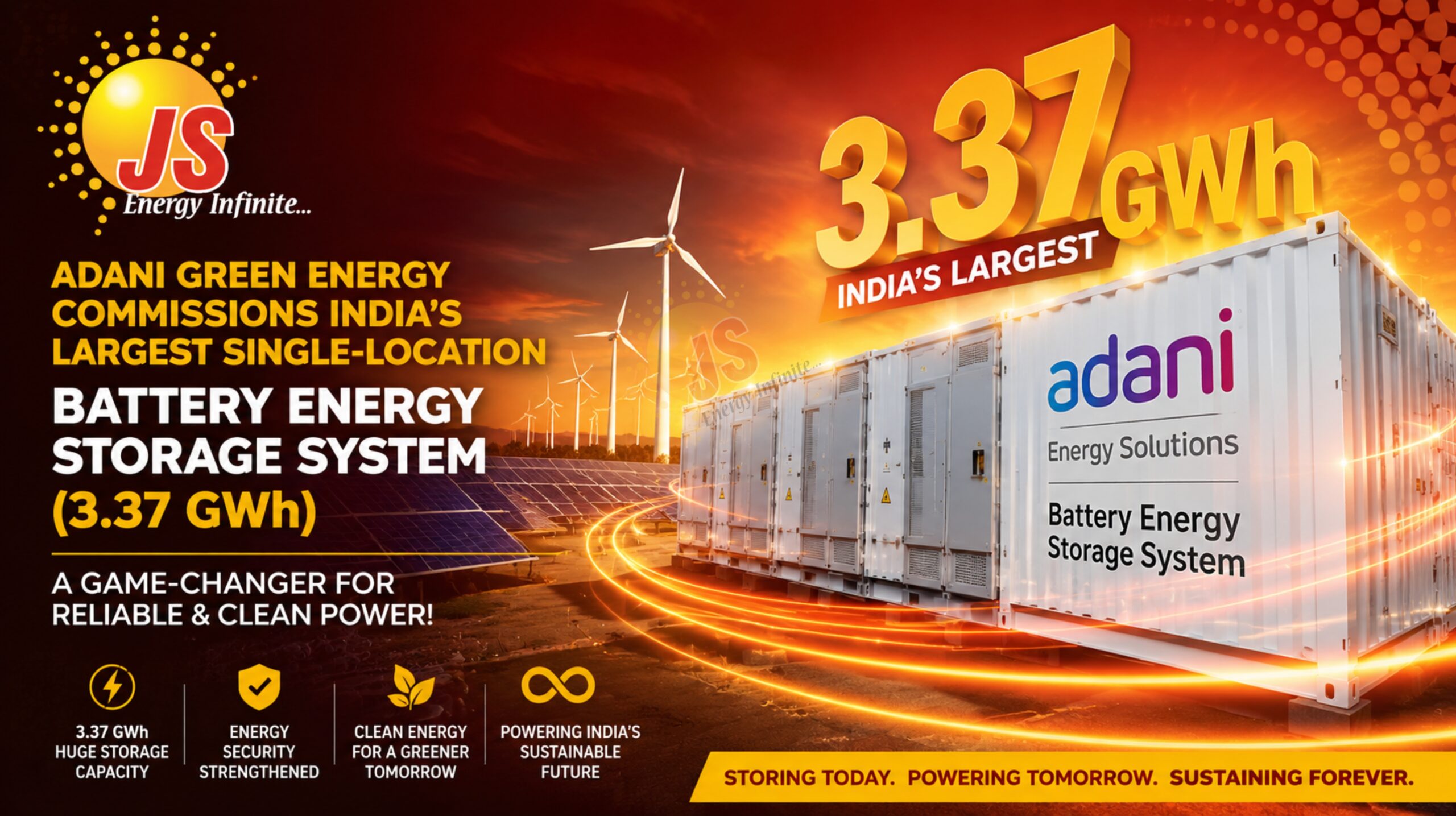
India has achieved a new milestone in the renewable energy sector that has significantly strengthened India’s clean energy infrastructure. As per sources, Adani Green Energy has successfully commissioned one of India’s largest single-location battery energy storage systems, which is 3.37 Gigawatt-hour (GWh). It is commissioned at Khavda, Gujarat making it the biggest battery storage facility that is built at one side outside China.
All About The 3.37 GWh Battery Energy Storage System:
The Battery Energy Storage System (BESS) is located at Khavda Renewable Energy Park. The project was previously commissioned as a 1.37 GWh-capacity operational battery in March 2026, and now the total capacity has increased to 3.37 GWh.
As per Adani Green Energy, the entire deployment process only took 10 months to complete, which makes it one of the fastest utility-scale battery storage projects across the globe.
The project is of high importance in India as solar panels only generate electricity during the day. Battery storage is quite vital in ensuring a consistent supply of renewable power, even during fluctuations in generation. Moreover, wind turbines also depend on wind conditions, which creates gaps in the overall electricity supply.
Battery storage systems solve this problem by storing the extra generated electricity and then releasing it later. These are quite beneficial as they offer:
- Better supply of electricity while improving grid stability
- Reduces the dependence on fossil fuels
- Makes renewable energy efficient while supporting India’s clean energy goals
With India’s rapidly expanding renewable energy capacity, establishing a massive battery storage infrastructure becomes crucial in order to maintain a reliable electricity network, stated Adani Green Energy.
How Big Is the 3.37 GWh Battery Storage System Project?
The project is estimated to be on a large scale. As per Adani Green Energy, the project is an integral part of the firm’s renewable energy development at Khavda. It showcases the company’s major investment in renewable energy storage infrastructure. The project can store enough electricity to power around one million homes for a day. It can aid in fulfilling large cities’ electricity needs even during peak demand hours.
“Large-scale energy storage will play a defining role in the next phase of India’s clean energy transition”, stated Mr Sagar Adani, Executive Director, AGEL.
Khavda: India’s Rising Energy Powerhouse:
With the development of multiple large-scale wind, solar, and battery storage projects, Khavda in Gujarat is eyeing to become the largest renewable energy hub across the globe.
With the commissioning of a 3.37 GWh Battery Storage System, Khavda is likely to hold a key position in India’s overall clean energy development.
How Beneficial Is It For India?
India is continuously working towards increasing the use of renewable energy and reducing overall carbon emissions, but the problem of dedicated storage remains. With these projects, it becomes easy to bridge the gap between electricity generation and consumption.
The battery storage system makes it possible to use renewable or clean energy, as it provides electricity without the need for sun or wind. The project sustains India’s renewable energy future with its dependable power storage.
It is a big step towards supporting clean energy that eliminates the need to depend on traditional energy sources and promotes clean energy usage. This indeed accelerates India’s transition to clean energy.
Conclusion:
The commissioning of a 3.37 GWh Battery Energy Storage System for Adani Green Energy is a strong step for supporting India’s renewable energy sector. It shows the advancement of science and focuses on the fact that advanced battery technology can support reliable electricity storage, ensuring continuous power for use.
With this project, India is taking a step closer to a cleaner, sustainable, and dependable future. Such projects are likely to solve electricity issues, making it easier to store and consume clean energy for homes, industries, and businesses in India.